
1st Cavalry Division
Get the Latest Updates
-
FOR IMMEDIATE RELEASE
Media Advisory 20150710-01
1st Cavalry Division Trooper retires after 43-year career
Photos and video from the retirement ceremony of Chief Warrant Officer 5 Jeanne Pace will be available on the 1st Cavalry Division DVIDS page following the conclusion of her retirement ceremony today, July 10.
Pace retired today in a ceremony on Cooper Field at Fort Hood, Texas after a 43-year career in the U.S. Army. She is the longest serving female warrant officer, last member serving of the 14th Women’s Army Corps Band, and among the longest tenured female Soldier in the Army’s active duty component.
Photos and b-roll can be found at the following link: https://www.dvidshub.net/unit/HQ-1CD
Headlines
-
FOR IMMEDIATE RELEASE
Media Advisory 20150710-01
1st Cavalry Division Trooper retires after 43-year career
Photos and video from the retirement ceremony of Chief Warrant Officer 5 Jeanne Pace will be available on the 1st Cavalry Division DVIDS page following the conclusion of her retirement ceremony today, July 10.
Pace retired today in a ceremony on Cooper Field at Fort Hood, Texas after a 43-year career in the U.S. Army. She is the longest serving female warrant officer, last member serving of the 14th Women’s Army Corps Band, and among the longest tenured female Soldier in the Army’s active duty component.
Photos and b-roll can be found at the following link: https://www.dvidshub.net/unit/HQ-1CD
-
FOR IMMEDIATE RELEASE
Media Advisory 20150702-01
1st Cav welcomes new Deputy Division Commanders in patch ceremony
WHO: All Media
WHAT: Media representatives are invited to observe.
WHEN: 9 a.m. July 7. All media will meet at the Fort Hood Visitor's Center at 7:45 a.m.
WHERE: Cooper Field, Fort Hood, Texas
WHY: Fort Hood and the First Cavalry Division are proud to welcome Brig. Gen. Mark C. Schwartz and Col. JP McGee to the First Team in a patch ceremony at Cooper Field Tuesday, July 7 at 9 a.m. Brig. Gen. Schwartz is taking over as the Deputy Commanding General for Maneuver while Col. McGee will be the Deputy Commander for Support.
The ceremony, presided over by division commander Maj. Gen. Michael Bills, will feature representative units from every battalion-sized element within the division, music from the First Team Band, and a formal review of the troops conducted on horseback.
Interested news media should register HERE
-
November 17, 2014 1st Cav to host Native American Heritage Month celebration
FORT HOOD, Texas -- The 2nd Brigade Combat Team, 1st Cavalry Division, will host the III Corps and Fort Hood Native American Heritage Month observance Thursday, Nov. 20 at 1:30 p.m., at the Phantom Warrior Center here.
The observance will include remarks from Col. Sean Bernabe, commander of 2nd BCT, guest speaker Lee "Eagleboy" Walters, Ph.D., a presentation of authentic Native American performances, and music provided by the 1st Cavalry Division Band.
The Phantom Warrior Center is located at building number 194 on 37th Street.
Media representatives interested in covering the event, please click here. Media wishing to attend must RSVP no later than 4 p.m. Nov. 19, 2014.
On August 3, 1990, President of the United States George H. W. Bush declared the month of November as National American Indian Heritage Month, thereafter commonly referred to as Native American Heritage Month.
-
FORT HOOD, Texas – The 1st Cavalry Division will honor Mrs. Elizabeth Laird, the "Hug Lady," Friday, Oct. 17, 2014, at 10 a.m. on Cooper Field here, just following the division color uncasing ceremony.The First Team will honor Laird with a presentation for her unwavering commitment and love for the Fort Hood community. She made it her mission in 2003 to hug every deploying and returning Fort Hood Soldier.
"I hug the Soldiers, because it's my way of saying thank you for what you do and the sacrifices you make, also it lets the Soldiers know they are cared for," said the 82-year-old Air Force veteran.
Media interested in covering this event, please click here to register. Media must register no later than Thursday, Oct. 16 at 5 p.m.
-
October 15, 2014 CORRECTION: First Team troopers to return home
CORRECTION: It was originally stated that the welcome home ceremony would be at 12:45 a.m. Thursday morning. The ceremony will be at 12:45 a.m. Friday, Oct. 17 (45 minutes after midnight).
FORT HOOD, Texas – Media are invited to attend the 1st Cavalry Division's welcome home ceremony Friday morning, Oct. 17 at 12:45 a.m. (45 minutes after midnight) on Cooper Field here.
Roughly 80 Soldiers from the Division Headquarters, including the division command team Maj. Gen. Michael Bills and Command Sgt. Maj. Andrew Barteky, will return home from their deployment to Afghanistan in support of Operation Enduring Freedom.
Media interested in covering this event, please click here to register. Media must register no later than Thursday, Oct. 16 at 5 p.m.
-
October 14, 2014 CORRECTION First Team headquarters to uncase colors
CORRECTION: The previous release stated that the ceremony would be Friday, Oct. 15. The ceremon will be Friday, Oct. 17 at 10 a.m.
FORT HOOD, Texas – Media are invited to attend the 1st Cavalry Division's colors uncasing ceremony Friday, Oct. 17 at 10 a.m. on Cooper Field here.The division command team, Maj. Gen Michael Bills and Command Sgt. Maj. Andrew Barteky, will uncase the division colors.
While more than 150 First Team headquarters troopers have returned from conducting operations in Afghanistan, nearly 90 Troopers will remain in a train, advise and assist capacity in support of Operation Resolute Support.
Media interested in covering this event, please click here to register. Media must register no later than Thursday, Oct. 16 at 5 p.m.
-
FORT HOOD, Texas – This fall, company-sized elements of Soldiers from 2nd Battalion, 8th Cavalry Regiment, 1st Brigade Combat Team, 1st Cavalry Division, will arrive in Latvia, Lithuania, Estonia and Poland to begin training exercises with those nations’ troops in support of Operation Atlantic Resolve.
The 2-8 Cav units will replace the paratroopers of the 173rd Airborne Brigade Combat Team, who have, since April, been participating in multinational training with U.S. allies in Estonia, Latvia, Lithuania and Poland.
These land training exercises, which came at the request of the host nations, help foster interoperability through small unit and leader training and demonstrate commitment to collective defense capabilities.Elements of the brigade have conducted training missions throughout the year in Europe.
For information on Operation Atlantic Resolve from the Department of Defense, go to: http://www.defense.gov/home/features/2014/0514_atlanticresolve/
Media wishing for more information, please contact the 1st Cavalry Division Public Affairs Office at 254-287-9400.
-

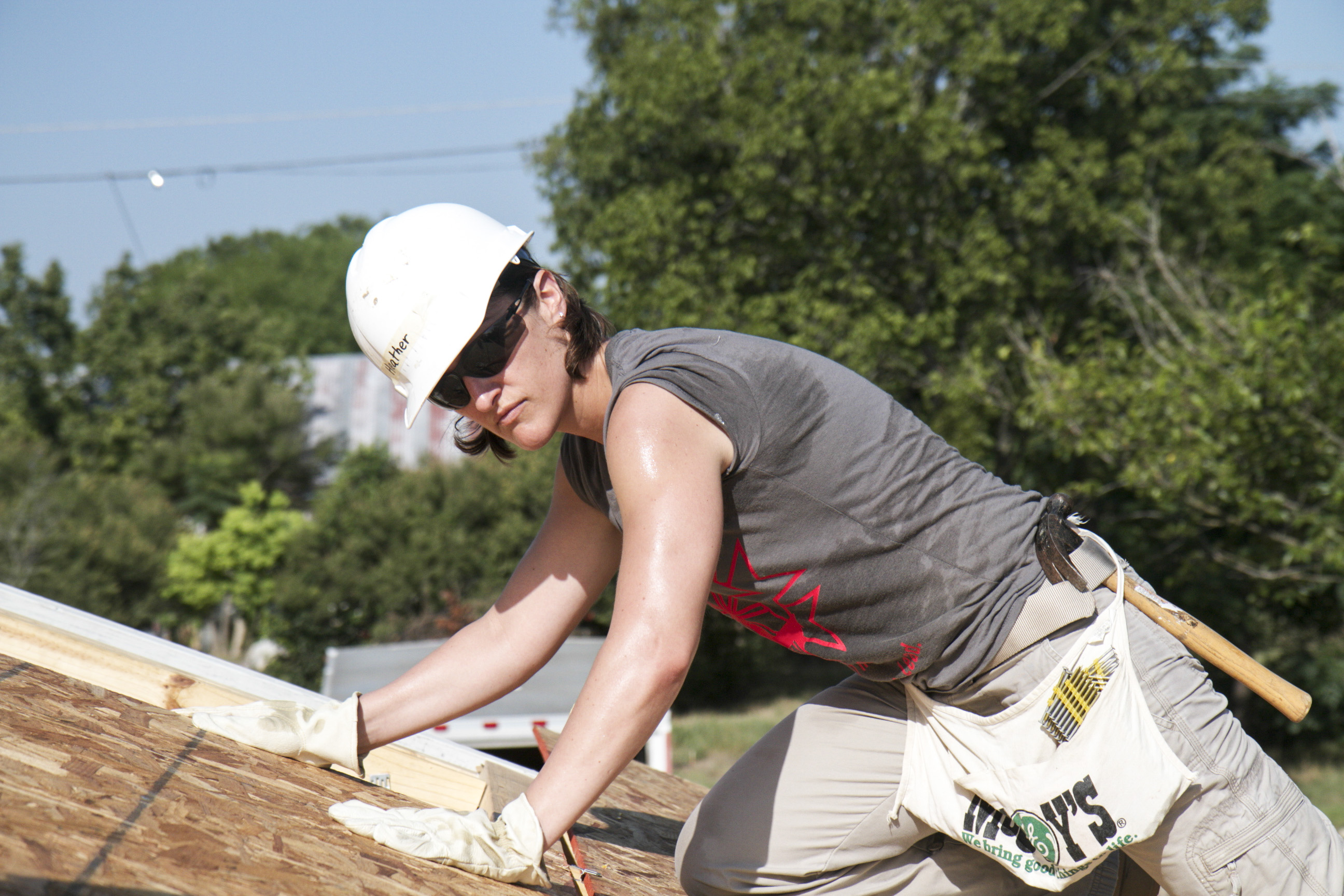
Maj. Heather Gunther, S-6 for 3rd Brigade Combat Team, 1st Cavalry Division and co-founder of the Fort Hood Women's Mentorship Network, and Maj. Christina Cook from 3rd Brigade Engineer Battalion, 3rd Brigade Combat Team, 1st Cav. Div., slide a sheet of plywood into place to form the roof of a Habitat-for-Humanity home in Jarrell, Texas, July 26. The volunteer project was coordinated by the Fort Hood Women's Mentorship Network to help build a home for a single mother whose apartment burned down last year. (U.S. Army photo by Staff Sgt. Leah R. Kilpatrick, 1st Cav. Div. PAO (released)
By Staff Sgt. Leah R. KilpatrickHQ, 1st Cav. Div. PAOJARRELL, Texas – In the afternoon of July 12, 2013, she was lying in bed recovering from recently being sick when the telephone rang. It was her apartment manager calling to inform her that her apartment complex had caught fire, and her apartment was among 16 that were affected.
Sherri Parsons has been busy twice a week beginning this month building her new house through the local Habitat-for- Humanity, a global non-profit organization that builds homes for people in need worldwide.
Parsons, who is a single mother, works as a school nurse during the school year and a camp nurse in Indiana during the summer months. She and her son were away at camp when the fire occurred.
Not only has Parson’s received the assistance of Habitat, but she got even more help from a group of Fort Hood Soldiers July 26, when members and supporters of the Women’s Mentorship Network spent the day volunteering to help build her house.
“Women’s Mentorship Network is a non-profit organization founded in January of this year, so we’re still relatively new but growing,” said Maj. Heather Gunther, 3rd Brigade Combat Team signal officer and co-founder of FHWMN. “We exist to create opportunities for women in the military to meet each other and create mentoring relationships.”
Amid the normal hustle and bustle of a construction site – the sounds of nail guns and electric shears and circular saws – Soldiers were making connections not just with each other, but with the local community.
“It’s really cool, because you have a diverse group that goes out and gets to meet people from the local area for a good cause, so it’s a cool opportunity for community outreach and to show some positive support for our organization and to give back a little bit too,” Gunther said.
Some of the Soldiers came with prior experience and some didn’t, but that didn’t stop them from rolling up their sleeves and lending a hand wherever they could.
“I’ve never done a project like this before,” said 1st Lt. Brad Fisk, 2nd Platoon, fire direction officer, Battery B, 3rd Battalion, 82nd Field Artillery Regiment, 2nd Brigade Combat Team. “It sounded like a fun way to spend a Saturday, and help somebody out, be productive and be outside. I’m really enjoying it. It’s a lot of fun.”
“We (the network) had done one other project like this down in Austin, and it was really enjoyable getting out and helping the families and also learning some construction skills and bonding with all the other members and supporters of the Women’s Mentorship Network,” said Capt. Briana Stremick from Company B, 3rd Brigade Engineer Battalion, 3rd BCT.
“You have the immediate impact of today’s efforts, but you have ideas now for junior leaders to go back to their units and bring their Soldiers back and create an opportunity to carry it forward within the ranks and to do community outreach there, so there’s a lot of really cool networking that goes on,” Gunther said. “You hear other people’s stories from the local community as well.”
Parson’s story is one of strength and resilience. While the circumstances that brought about the build might have been catastrophic to anyone else, Parsons and her 10-year-old son, Dominick, have persevered and maintained a positive attitude.
“I’m the type of person that I believe there is nothing you can do about things like that (the fire),” Parsons said. “You can drive yourself crazy about it, or you can move on, so at that point I knew there was nothing I could do, and I still had a month left to work at camp, so I called the insurance company and let them handle it. I was actually just kind of numb for a little bit.”
Parsons said the reality of the situation didn’t really sink in until she and Dominick returned to Round Rock at the end of the summer and had no place to go.
At the start of the day, the house looked like an empty shell covered in housewrap, but by day’s end, it was sporting roofing materials and soffit, and the siding installation had begun.
The home was taking shape.
“It was great to work with some experienced people,” said Capt. Julie Leggett, commander of Company C, 3rd BEB and organizer of the event. “We’ll probably do another one six weeks from now. It’d be great to come back and put some finishing touches on Sherri’s house and get to see her toward the end when she’s about ready to move in.”
“It’s a wonderful feeling,” Parsons said about being a homeowner. “I appreciate things anyway, but when you build something from the ground up, you really appreciate it.”

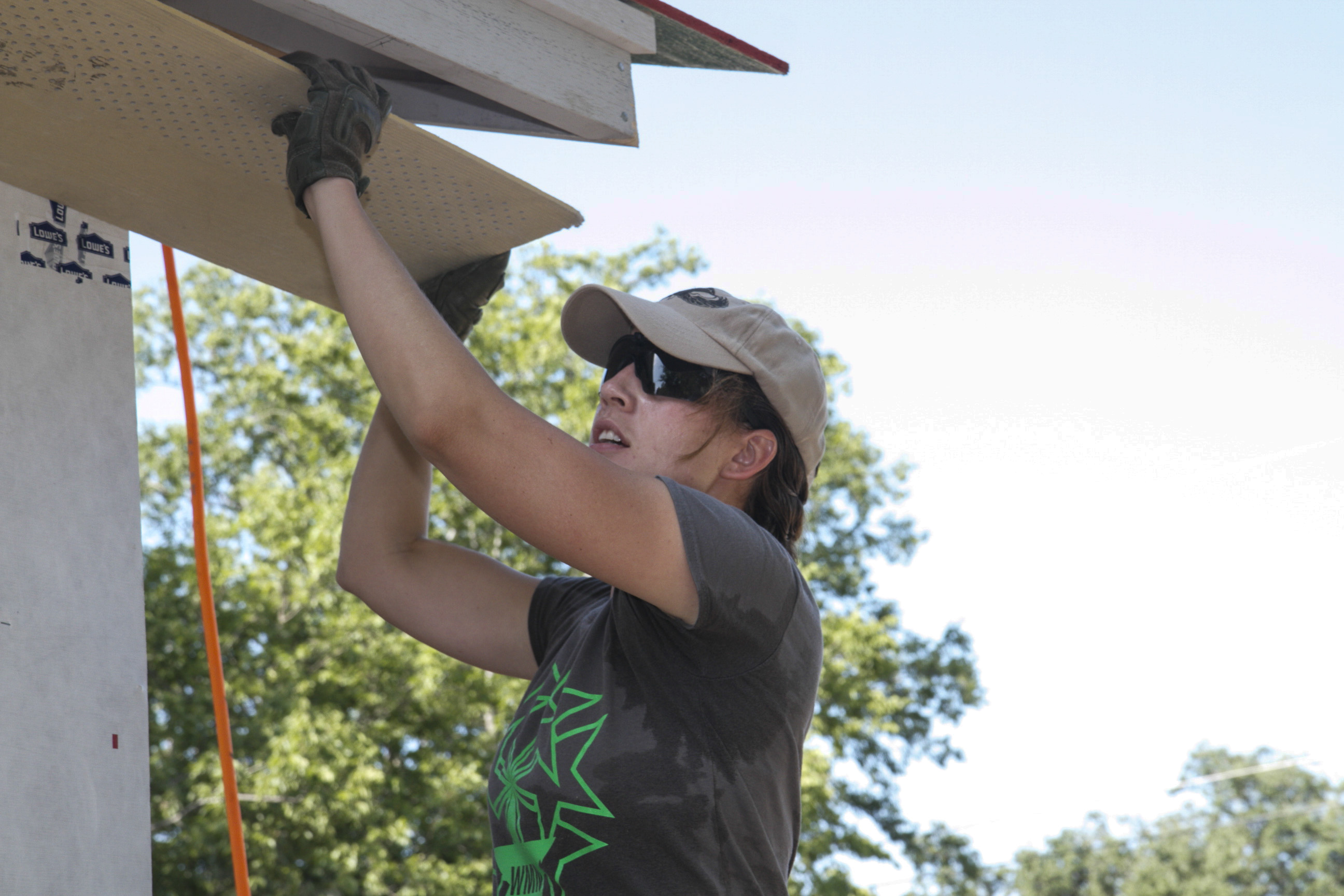
1st Lt. Brad Fisk, fire direction officer for 2nd Platoon, Battery B, 3rd Battalion, 82nd Field Artillery Regiment, 2nd Brigade Combat Team, 1st Cavalry Division, places a sheet of soffit to form the eaves of a Habitat-for-Humanity home in Jarrell, Texas, July 26 as part of a volunteer opportunity coordinated by the Fort Hood Women's Mentorship Network. The home is being built for a single mother whose apartment burned down in July 2013. (U.S. Army photo by Staff Sgt. Leah R. Kilpatrick, 1st Cav. Div. PAO (released)
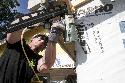
1st Lt. Brad Fisk, fire direction officer for 2nd Platoon, Battery B, 3rd Battalion, 82nd Field Artillery Regiment, 2nd Brigade Combat Team, 1st Cavalry Division, nails a sheet of soffit in place to form the eaves of a Habitat-for-Humanity home in Jarrell, Texas, July 26 as part of a volunteer opportunity coordinated by the Fort Hood Women's Mentorship Network. The home is being built for a single mother whose apartment burned down in July 2013. (U.S. Army photo by Staff Sgt. Leah R. Kilpatrick, 1st Cav. Div. PAO (released)

Sherri Parsons, a single mother whose apartment burned down last year, holds a ladder for a Habitat-for-Humanity worker during the build of her new home in Jarrell, Texas, July 26. "I appreciate things anyway, but when you build something from the ground up, you really appreciate it," Parsons said. (U.S. Army photo by Staff Sgt. Leah R. Kilpatrick, 1st Cav. Div. PAO (released)
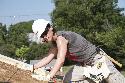
Maj. Heather Gunther, S-6 for 3rd Brigade Combat Team, 1st Cavalry Division and co-founder of the Fort Hood Women's Mentorship Network, slides a sheet of plywood into place to form the roof of a Habitat-for-Humanity home in Jarrell, Texas, July 26. The volunteer project was coordinated by the Fort Hood Women's Mentorship Network to help build a home for a single mother whose apartment burned down last year. (U.S. Army photo by Staff Sgt. Leah R. Kilpatrick, 1st Cav. Div. PAO (released)
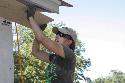
Capt. Julie Leggett, commander of Company C, 3rd Brigade Engineer Battalion, 1st Cavalry Division, properly seats a sheet of soffit to form the eaves of a Habitat-for-Humanity home in Jarrell, Texas, July 26 as part of a volunteer opportunity coordinated by the Fort Hood Women's Mentorship Network. The home is being built for a single mother whose apartment burned down in July 2013. (U.S. Army photo by Staff Sgt. Leah R. Kilpatrick, 1st Cav. Div. PAO (released)

Capt. Briana Stremick of Company B, 3rd Brigade Engineer Battalion, 1st Cavalry Division, holds a sheet of soffit in place to form the eaves of a Habitat-for-Humanity home in Jarrell, Texas, July 26 as part of a volunteer opportunity coordinated by the Fort Hood Women's Mentorship Network. The home is being built for a single mother whose apartment burned down in July 2013. (U.S. Army photo by Staff Sgt. Leah R. Kilpatrick, 1st Cav. Div. PAO (released)
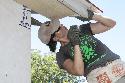
Capt. Julie Leggett, commander of Company C, 3rd Brigade Engineer Battalion, 1st Cavalry Division, properly seats a sheet of soffit to form the eaves of a Habitat-for-Humanity home in Jarrell, Texas, July 26 as part of a volunteer opportunity coordinated by the Fort Hood Women's Mentorship Network. The home is being built for a single mother whose apartment burned down in July 2013. (U.S. Army photo by Staff Sgt. Leah R. Kilpatrick, 1st Cav. Div. PAO (released)
-
September 12, 2013 1st Cavalry Division commander to pin second star
FORT HOOD, Texas -- The 1st Cavalry Division will host a promotion ceremony for Commanding General Brig. Gen. Michael Bills at 2 p.m. June 27 at the division headquarters' Cooper Field.
Bills took command of the division in March and will soon deploy along with roughly 300 “First Team” troopers who will serve as the Regional Command - South headquarters focused on advising and training the Afghan National Security Forces.
Anyone interested in covering the event, please click here.
-
May 29, 2014 Cav spouse emerges victorious from personal struggle

By Staff Sgt. Leah R. Kilpatrick
HQ, 1st Cav. Div. PAO
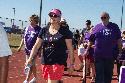
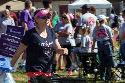
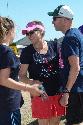
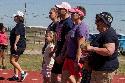
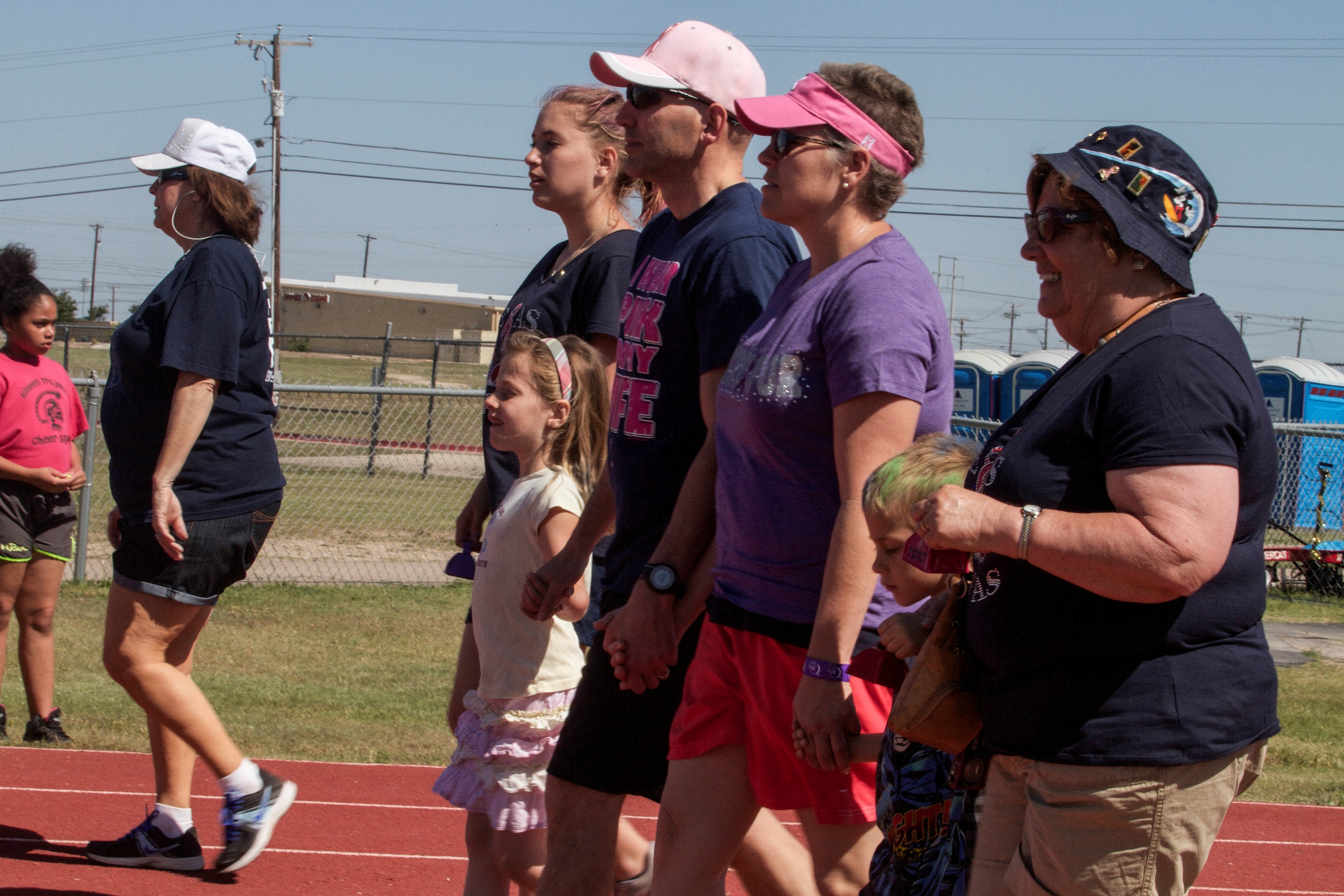
FORT HOOD, Texas – With every step and every lap around the track at Robert M. Shoemaker High School in Killeen, Texas, one 1st Cavalry Division spouse closed an arduous and emotional chapter of her life.
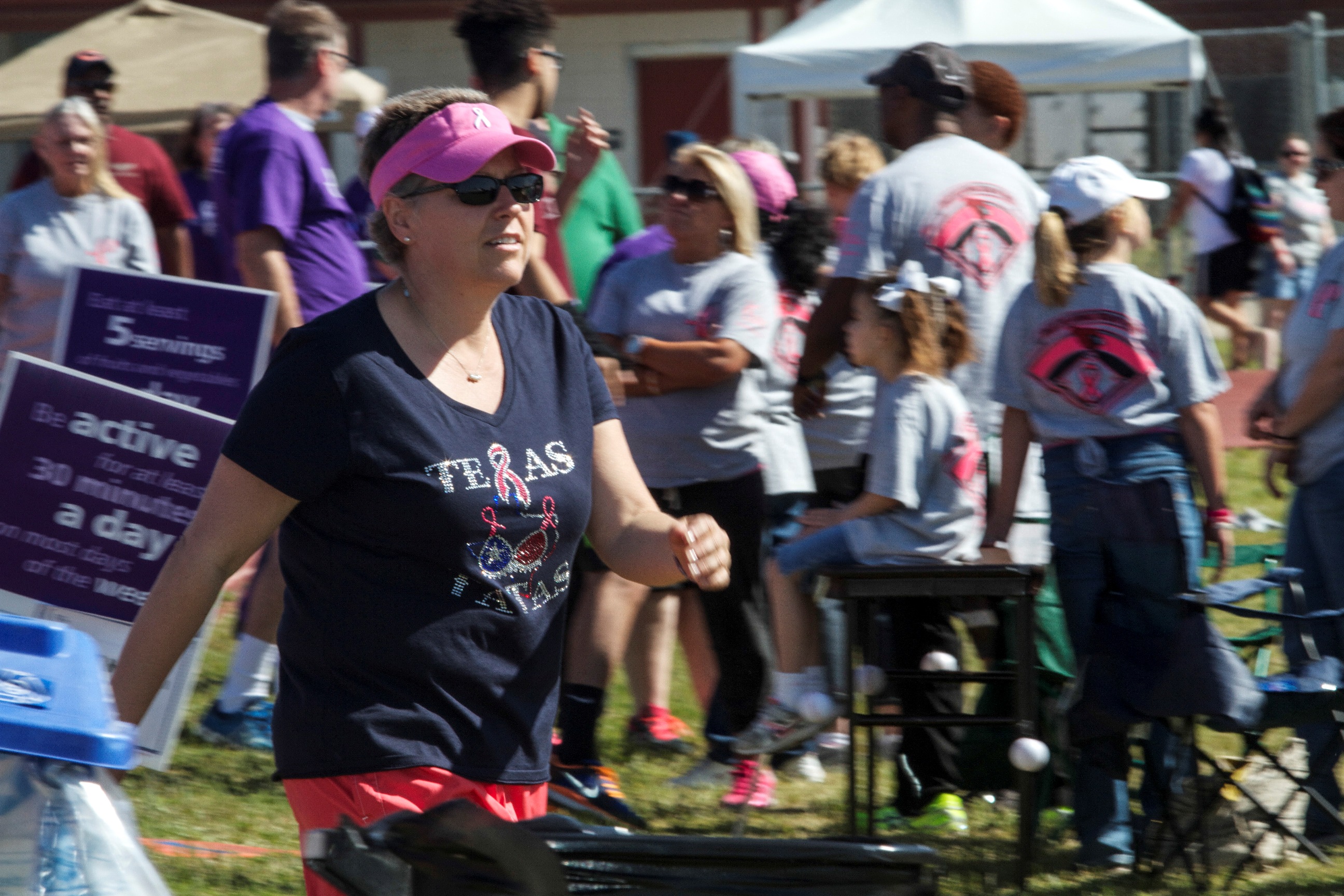
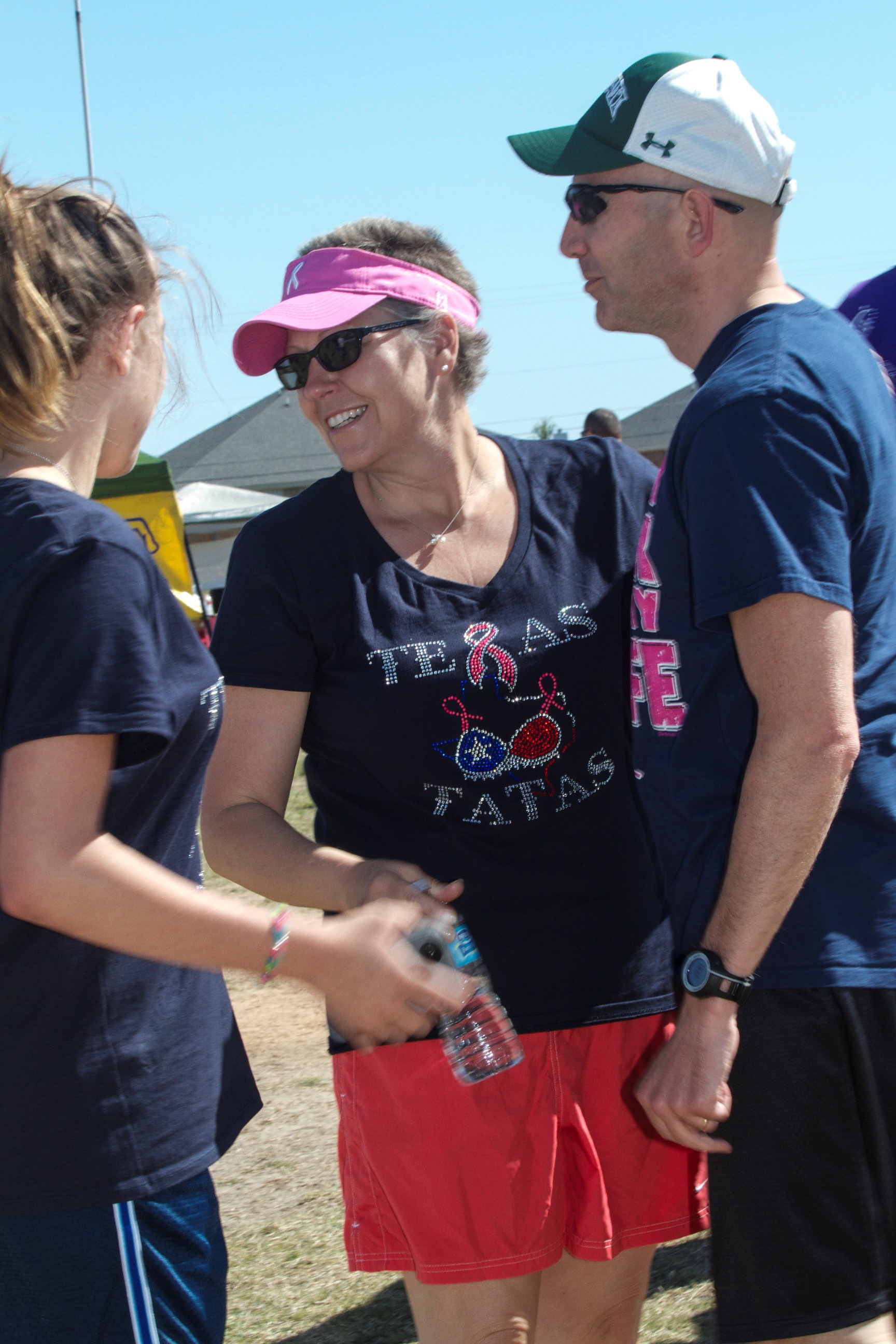
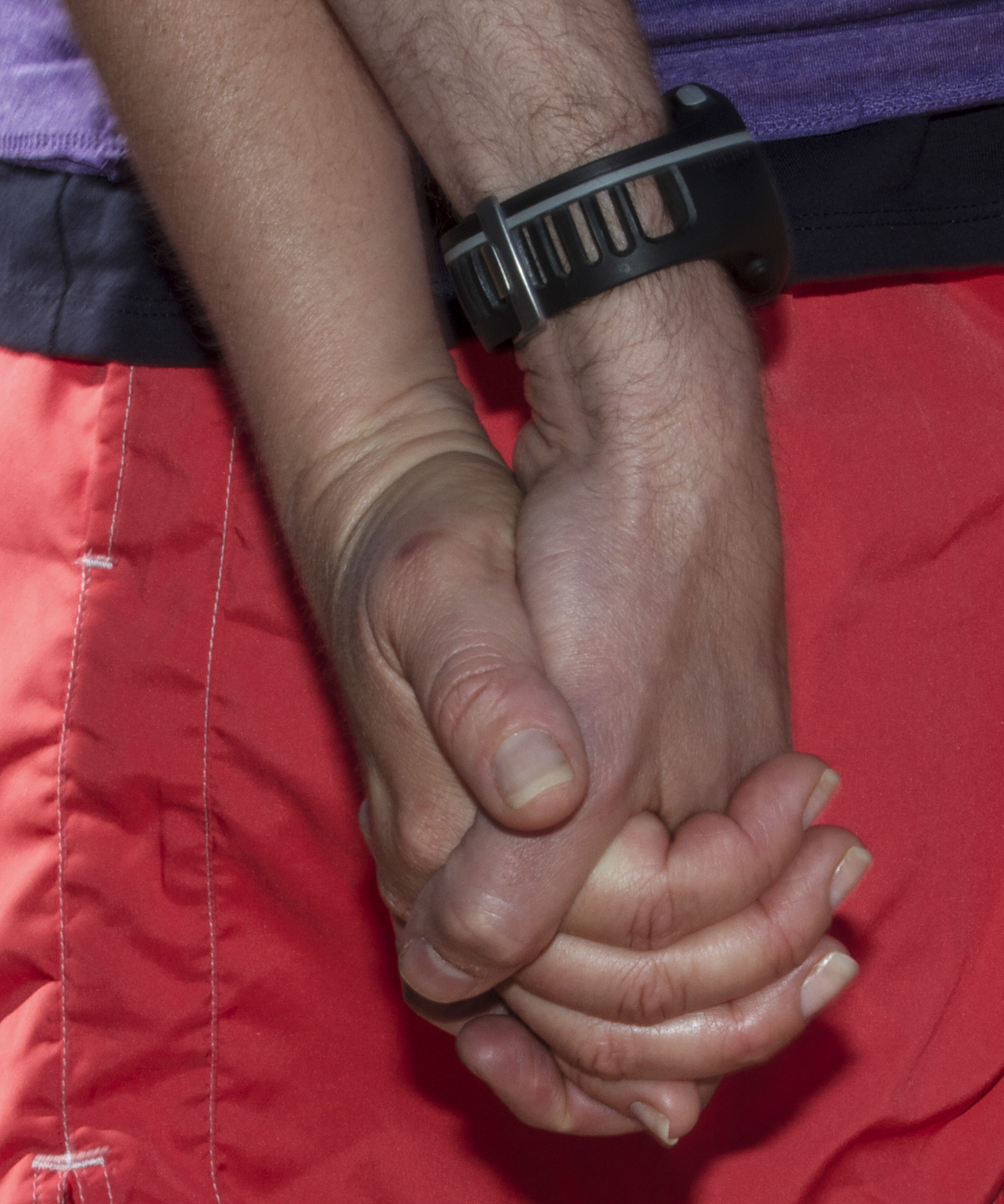
After a yearlong struggle with cancer, Shawna Niles, wife of Lt.Col. Rolland Niles, the 1st Cavalry Division deputy chief of staff, is cancer-free. At the track, she took several victory laps as part of the American Cancer Society’s Relay for Life fundraising event May 3.
"I got diagnosed June 6 last year,” said Shawna, a native of Decatur, Illinois. “It’s been about a year or two that they’ve been watching a spot and said there was nothing, but my gut and God just told me that there was something wrong.”
After an MRI, an ultrasound and a biopsy, Shawna was diagnosed with breast cancer. She was at the Spirit of Fort Hood Chapel doing her work as the Protestant Women of the Church president when she got the call and immediately went to tell her husband.
“I drove right over to his office to tell him and . . . Chaplain (Addison) Burgess (the then-division chaplain) was in the parking lot,” she said. “I couldn’t contain myself to go find him, so he escorted me up to his office to take me to him, so I could tell him.”
“It was a surprise,” said Rolland, a native of Avon, Illinois. “I knew she was having the test, but you always hope that it’s going to be negative. I didn’t think she would have cancer.”
The fight against the cancer immediately began in earnest.
In July, she had surgery to remove cancer from the breast.
“A week later, they found out that they didn’t get all the cancer, and they did another surgery a week later to remove the cancer . . .” Shawna said.
The doctors then started chemotherapy in August and radiation in February.
“I felt so horrible I thought I was going to die,” she said.
She attributes the strength she mustered to come through her ordeal to an extensive support system.
“It’s been tough,” she said. “Not being able to take care of my family, do my duties as a wife. It’s been tough, but the Cav Family was very gracious to help us. The wives made meals once a week to twice a week . . . Just a lot of support from the wives.”
Even after struggling to regain her health and confessing to the difficulty of that struggle, Shawna said, “The hardest part was everybody having to wait on me.”
“As a wife, you never want to be the person that holds your husband back from his career,” Shawna said. “You feel like, ‘I can’t let this bleed into his work.’ Col. (Robert) Akam (former First Team chief of staff) said to me at his farewell, ‘You are first now.’”
Shawna has been an Army spouse for 17 of Rolland’s 21 years in uniform.
“It was time to give back,” Rolland said. “The family makes sacrifices for the Soldier, so it was my opportunity to make sacrifices for her. The command group was very flexible in giving me the time I needed to get away for chemo. I mean, she would be there for three and a half to four hours plugged up to machines.”
Sometime in January, the idea occurred to Shawna to participate in Relay for Life. She polled her friends to see if anyone would support her. She said she didn’t think she could go do it alone, because she still suffers from some side effects of her treatment, like nerve damage and fatigue. Her church family and friends rallied behind her.
Relay for Life is the American Cancer Society’s community fundraising event, during which teams camp out overnight with at least one member of each team on the track at all times for up to 24 hours.
For Rolland, getting to see all the survivors served as a testament to the possibility of survival.
“Coming here, you get to see everybody else,” Rolland said. “It just reinforces that you can survive. These are all success stories that you see walking around here.”
Not so long ago, she couldn’t even get out of bed, but back at the track and before the walk began, Shawna couldn’t stay put. She was busy setting up her tent and arranging decorations. She darted all around, asking people if they needed anything, taking care of people, and trying to give back to some of those who helped her during her journey.
Hundreds turned out for the relay. For Shawna, participating helped bring closure in her battle.
“I think I needed to be here today to say it’s done,” Shawna said, “to shut the door, to close it, to say I can move on.”
-
May 29, 2014 First Team, community come together
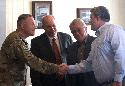
Brig. Gen. Michael Bills (left), commander of the 1st Cavalry Division, greets board members of the Greater Killeen Chamber of Commerce in Killeen, Texas, May 20. Bills met with the board members to discuss the division’s mission overseas and here at Fort Hood. “It’s a great honor to come here and represent the 1st Cavalry Division among this group of representatives and leaders from our great community,” Bills said. (U.S. Army photo by Sgt. Angel Turner, 1st Cav. Div. PAO (Released).
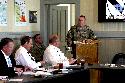
Brig. Gen. Michael Bills, commander of the 1st Cavalry Division, speaks to board members of the Greater Killeen Chamber of Commerce in Killeen, Texas, May 20. Bills discussed the division’s current missions around the world and how those missions impact the local area. “The support you all provide our Soldiers and Families is something that cannot be recognized enough, and for that, you have my personal thanks,” Bills said. Bills also listened to the board members’ monthly meeting and heard the current and future plans for the city. (U.S. Army photo by Sgt. Angel Turner, 1st Cav. Div. PAO (Released).
-
May 9, 2014 4-3 Cav to support peacekeeping in Sinai
FORT HOOD, Texas – The 1st Cavalry Division announced today a reconnaissance squadron task force from the 3d Cavalry Regiment will deploy to Egypt’s Sinai Peninsula this summer as part of the Multinational Force and Observers peacekeeping force.
The 4th Squadron, 3d Cavalry Regiment, 1st Cavalry Division, will observe and report adherence to the Egyptian-Israeli peace treaty during its nine-month deployment. The 400-plus Soldier U.S. “Longknife” squadron will man observation posts along the southeast coast of the Sinai Peninsula between Taba and Sharm-el-Sheikh, Egypt. The peacekeeping mission will mark the first deployment for the Longknife Squadron since it was formed in November 2010.
The squadron developed a comprehensive training program in November 2013 aided by dialogue with members of 6-9 Cav, the unit currently carrying out the MFO mission. Longknife troopers executed individual, leader, and comprehensive training exercises spanning a wide range of mission-specific skills that culminated in a multi-day MFO squadron training scenario.
A series of mobile training teams traveled to Fort Hood over the past few months to train 4th Squadron Soldiers on a variety of specific tasks, from cultural awareness and slingload operations, to up-armored vehicle driving.
The MFO is a result of the Camp David Accords and resulting 1979 Treaty of Peace and its 1981 Protocol, which were signed by Egyptian President Anwar Sadat and Israeli President Menachem Begin, and witnessed by U.S. President Jimmy Carter. The MFO force in the Sinai is currently comprised of service members from 13 nations. U.S. forces have participated in the MFO mission since its inception in 1982.
For more information concerning Multinational Force and Observers-Sinai, visit their webpage at http://www.MFO.org. For more information on 4-3 Cavalry, contact 3d Cavalry Regiment, 1st Cavalry Division Public Affairs Office at (254) 553-6780.
-
June 17, 2013 4th Brigade, 1st Cav Redeployment ceremonies scheduled
FORT HOOD, Texas -- The 1st Cavalry Division is slated to host two Redeployment Ceremonies this weekend for the 4th Brigade Combat Team at Cooper Field here.
The first ceremony is tentatively scheduled for 7:45 p.m., 6 Jul. This flight is slated to include the command team of 1-9 Cav and an uncasing ceremony of the battalion's colors will be part of the festivities. Interested media must register for this flight here.
The second ceremony is tentatively set for 7:15 p.m., 7 July and will include an uncasing ceremony for the 4th BSTB. Media interested in covering this ceremony must register here.
Please note that ceremony times are subject to change.
-
June 17, 2013 4th Brigade, 1st Cav Advon flight headed home
FORT HOOD, Texas -- The 1st Cavalry Division is slated to host a Redeployment Ceremony June 20 at 5:30 p.m. for the 4th Brigade Combat Team's Advon flight at Cooper Field here.
Please note that ceremony times are subject to change.
Anyone interested in covering the event, must register here.
-
June 19, 2013 6-9 Cav. to support peacekeeping in Sinai
FORT HOOD, Texas – The 1st Cavalry Division announced today a battalion task force from the 3rd Brigade Combat Team will deploy to Egypt’s Sinai Peninsula this summer as part of the Multinational Force and Observers peacekeeping force.
The 6th Squadron, 9th Cavalry Regiment, 3rd Brigade Combat Team, 1st Cavalry Division, will observe and report violations of the Egyptian-Israeli peace treaty during its nine-month deployment. The 400-plus Soldier U.S. battalion will be based on the southern end of the Sinai Peninsula, near Sharm-el-Sheikh. The U.S. Soldiers will man observation posts and check points along the southeast coast of the Sinai Peninsula between Eilat, Israel and Sharm-el-Sheikh, Egypt.
The 3rd Brigade Combat Team's 6th Squadron, 9th Cavalry most recently assisted with the drawdown of U.S. Forces in Iraq and the training of Iraqi security forces. The unit returned to Fort Hood from Iraq in the fall of 2011. The squadron recently completed a rotation at the National Training Center, Fort Irwin, Calif., and has spent six months training to accomplish this peacekeeping mission.
The MFO is a result of the 1979 Camp David Peace Accords, which were signed by Egyptian President Anwar Sadat, Israeli President Menachem Begin, and U.S. President Jimmy Carter. The MFO is currently comprised of 13 nations. U.S. forces have participated in the MFO mission since its inception in 1982.
For more information concerning Multinational Force and Observers-Sinai, visit their webpage at http://www.MFO.org. For more information on 6-9 Cavalry, contact 3rd Brigade Combat Team, 1st Cavalry Division Public Affairs Office at (254) 288-9598.
--30--
-
June 19, 2013 First Team's Long Knife Brigade begins return home
FORT HOOD, Texas -- The 1st Cavalry Division is slated to host a Redeployment Ceremony June 20 at 1:45 a.m. for the 4th "Long Knife" Brigade Combat Team's Torch-1 flight at Cooper Field here.
Please note that ceremony time is subject to change.
Anyone interested in covering the event, please click here.
-
FORT HOOD, Texas -- The 1st Cavalry Division is slated to celebrate the Army's 238th birthday with a cavalry-style cake cutting June 14 at 3:45 p.m. at the division headquarters.
Following the cake cutting is a ceremony to promote Col. Joseph M. Martin, deputy commanding general for maneuvers, 1st Cavalry Division, to brigadier general at 4:30 p.m., Cooper Field.
Anyone interested in covering the events, please click here.
-
January 29, 2013 1st Cavalry Division hosts veterans for annual reunion
FORT HOOD, Texas -- The 1st Cavalry Division is hosting veteran Cav Troopers and their families from across the country June 7 for the annual 1st Cavalry Division Reunion here.
Events are scheduled to take place at the division’s museum, Horse Cavalry Detachment and the division headquarters at Cooper Field.
The museum will offer special displays and living history presentations to include actors in period costume. Media wishing to cover the events at the museum should register here.
The Horse Cavalry Detachment will be open throughout the day for tours and a demonstration at 3 p.m. Media wishing to cover events at the detachment should register here.
The day’s activities will finish with a “Spirit of the Cav” presentation at the division headquarters’ Cooper Field beginning at 6 p.m. Media wishing to cover the evening ceremony should register here.
For more information please contact the 1st Cavalry Division Public Affairs Office at 254-287-9400.
-
April 10, 2013 LANDCOM general visits 1st Cav
Lt. Gen. Frederick Hodges (right), commanding general for NATO's Allied Land Command, chats with Lt. Col. Kirk Luedeke (left), public affairs officer for the 1st Cavalry Division, after a meeting with a few leaders of the division April 6 at the Cav's Headquarters at Fort Hood, Texas. (Photo by Sgt. Kim Browne, 1st Cavalry Division PAO)
By Sgt. Kim Browne
1st Cav. Div. Public AffairsFORT HOOD, Texas - NATO is an active and leading advocate for peace and security on the international stage. Through its many operations, the Alliance has proved both its willingness to act as a positive force for change today and its capacity to anticipate the security challenges of the future.
Lt. Gen. Frederick B. Hodges, commanding general for NATO’s Allied Land Command in Izmir, Turkey, presented an orientation and briefing April 6 here to officers and leaders of the 1st Cavalry Division about the activation of LANDCOM and NATO’s Command Structure transformations.
As part of NATO’s vision to reflect the realities of economic austerity and next year’s transition in the Afghan theater, the NCS streamlined its organization from 11 to six headquarters. LANDCOM was activated on Nov. 30, 2012, replacing the two land component commands in Heidelberg, Germany and Madrid, Spain, and retains sole responsibility for the standardization and interoperability of all land forces from the 28 member nations that comprise the most successful alliance in history.
“My headquarters exists primarily to ensure that we retain the effectiveness and interoperability of all NATO land forces,” Hodges said. “NATO has become more active in preventing conflict rather than waiting to be attacked.”
Before his arrival to Fort Hood, Hodges visited the U.S. Army Command and General Staff College at Fort Leavenworth, Kan., to talk to the students and see what capabilities the U.S. Army has for training and doctrine.
Hodges discussed many of the changes the Alliance is making, such as the U.S. Army collaborating with LANDCOM and regionally aligning NATO land forces around the globe.
“The 1st Cavalry Division could potentially have a role in the Regionally Aligned Force, so I wanted to come talk to the commander, talk to the leaders and see how they were training and preparing,” Hodges said.
RAF is a concept to develop innovative new approaches for helping entire units to work with and among partner nation security forces.
“The Alliance realized that it had to transform for life after (International Security Assistance Force), post-2014, so it could meet the security requirements of its member nations, but at an affordable, sustainable level,” Hodges said
Since NATO’s creation just after WWII, the first several decades of NATO’s existence saw a focus on training and preparation for potential conflict with the Soviet Union, but with the dissolution of the Warsaw Pact nations, its focus changed to territorial integrity
Following the end of the Cold War, the Bosnian support and stability mission in the 1990’s, known as Operation Joint Endeavor, was the first time NATO had assisted a country that was not a NATO member.
The 9/11 attacks on the U.S. in 2001, was the first time in the Alliance’s history that Article 5 of the NATO treaty (“An attack on one is an attack on all”) has ever been invoked. Since then, NATO has had forces deployed to Afghanistan to lead ISAF, while conducting anti-piracy, air policing and other contingency operations around the globe.
“NATO exists to ensure the security of all of its member nations,” he added. “We must never lose our capability of reacting quickly because we enjoy a long and successful history of training, exercising and deploying together.”
“Unless we are responding to a direct attack on our soil, the U.S. Army cannot conduct large-scale, sustained operations alone in multiple theaters, nor should we,” he concluded.
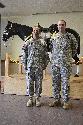
Lt. Gen. Frederick Hodges (right), commanding general for NATO's Allied Land Command, and Maj. Gen. Anthony Ierardi (left), commanding general for the 1st Cavalry Division, pause for a photo after Hodges met with Ierardi and other Cav Troopers April 6 at the division's headquarters at Fort Hood, Texas. (Photo by Sgt. Kim Browne, 1st Cavalry Division PAO)
-
March 26, 2013 1st Cav Soldier helps family from fire
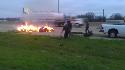
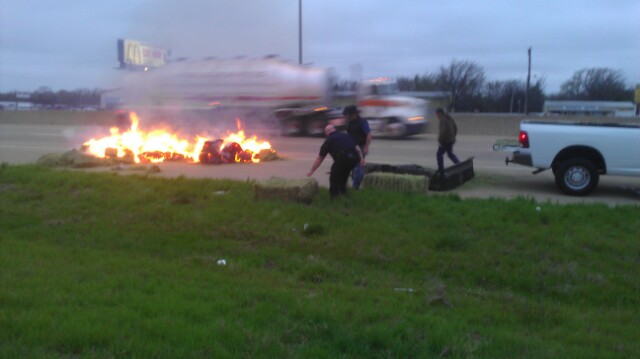
Police officers and firemen help control a hay bale fire March 22, on U.S. 75 North near Van Alstyne, Texas. Spc. Wayne Byers noticed the hay on fire in the back of a pickup truck and helped remove the hay before it burned up the vehicle and its occupants. (Photo by Spc. Wayne Byers, 1st Cav. Div.) By Sgt. Kim Browne
1st Cav. Div. Public AffairsVAN ALSTYNE, Texas – While driving north on U.S. 75 through Dallas, the last thing a person may expect to see is fire coming from the back of a pickup truck -- but for a 1st Cavalry Division Trooper, it was a reality and a cause for selfless action.
Dallas native Spc. Wayne Byers, a Soldier with the 1st Cav. Headquarters, pulled over behind the pickup and began throwing burning bales of hay out of the back March 22 near Van Alstyne, Texas.
“I was headed to get my Mom so we could attend my daughter’s piano recital,” Byers said.
Byers had been following the pickup truck for a mile or more as smoke billowed from the bed. The truck started to pull over and the hay bales caught fire.
He acted by grabbing his thermal undershirt, remembering its flame retardant capabilities, to attempt to smother the fire, but to no avail. He then began pulling the hay bales from the truck and telling the driver to get out and get her children out. Byers then rushed to the passenger side of the vehicle to pull one of the two children out.
After assisting with the children he returned to the pickup and pulled it forward and away from the burning hay. Byers and the others, who were assisting, also pulled the smoldering bed liner from the pickup as to keep the truck from burning up.
“He helped out a vehicle from burning,” said Officer Jonathan Hunter, a police officer with the Van Alstyne, Texas Police Department. “He assisted with removal of the hay bales and further damage to the truck and I would personally like to thank him.”
Once the police and fire department showed up, Byers felt that he had accomplished his mission.
“I just felt that I had to get the kids away and get the fire out,” Byers explained. “I felt like I did what I should have done or what anyone should have done and I would do it again.”
Master Sgt. Dara Wydler, commandant for the 1st Cavalry Division, stated Byers embodies the seven Army Core Values such as personal courage; especially knowing that he could get hurt or burned himself.
“It’s a great thing to have Soldiers like that,” Wydler said. “It makes other Soldiers rethink and relook at themselves and maybe question what they would or would not do.”
For Byers the incident ended just as quick as it had began and for Soldiers like Byers it shows the epitome of the Army Values with emphasis on selfless service and personal courage.
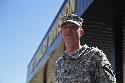
Spc. Wayne Byers, a Soldier with the 1st Cavalry Division’s Commandant Section, pauses for a photo March 26 at the 1st Cav. Headquarters at Fort Hood, Texas after discussing the actions he took to help save a family and their vehicle from burning up. Byers noticed hay on fire in the back of a pickup truck and helped remove the hay before it burned up the vehicle and its occupants. (Photo by Sgt. Kim Browne, 1st Cavalry Division PAO)
-
April 5, 2013 1st Cavalry Division Patch Ceremony April 5
FORT HOOD, Texas -- The 1st Cavalry Division is slated to host a Patch Ceremony, April 5 at 10 a.m. at the division headquarter's Cooper Field.
The Cav will be saying farewell to Brig. Gen. Laura Richardson, deputy commanding general for support, and welcoming Col. Joseph Martin, commander of the Operation Test Command, as Richardson's replacement.
Anyone interested in covering the event, please click here.
-
March 11, 2013 Former 8th Cav Troop to receive Medal of Honor
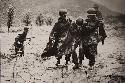
Chaplain (Capt.) Emil Kapaun (right), former chaplain with Headquarters Company, 8th Cavalry Regiment, 1st Cavalry Division, helps another Soldier carry an exhausted Troop off the battlefield early in the Korean War.
By Sgt. Kim Browne
1st Cav. Div. Public AffairsFORT HOOD, Texas - A former Soldier with the 8th Cavalry Regiment, 1st Cavalry Division will be posthumously awarded the Medal of Honor at the White House, April 11.
Chaplain (Capt.) Emil Joseph Kapaun served with Headquarters Company, 8th Cav. in the Korean War where he was posthumously awarded the Distinguished Service Cross Aug. 18, 1951. The award of the Medal of Honor to Chaplain Kapaun is an upgrade of the DSC.
Father Kapaun, also a World War II veteran, sacrificed his own safety while the regiment was attacked by hostile forces and he moved among the wounded to provide medical aid and comfort.
At dusk Nov. 2, 1950, the Troops who were able to fight were ordered to attempt to break through the surrounding enemy. Fr. Kapaun however, remained behind to administer medical treatment and render religious rites wherever needed.
Upon capture, Kapaun and other POWs were forced to walk more than 85 miles to the city of Pyoktong, North Korea. While forcibly walking this march through snow and ice, Kapaun assisted the wounded and encouraged other Soldiers to do the same.
While he was held captive, he snuck around to more than 200 men that were also captive to say prayers and give support. He also secretly moved able-bodied men out to the countryside at night, while avoiding guards, to get food and firewood to help keep the prisoners alive. At this point the other POWs had dubbed him the “good thief.”
Kapaun was a Prisoner of War from Nov. 2, 1950 until he died from a blood clot May 23, 1951.
“Father Emil Kapaun is an American hero who embodies the Medal of Honor’s ideals as our nation’s highest award for military service,” said Maj. Gen. Anthony Ierardi, commanding general of the 1st Cavalry Division, here. “He distinguished himself with valor before his capture and continued to care for his fellow Soldiers at a great risk to himself while interned in a Prisoner of War Camp. Although Father Kapaun did not survive to be liberated along with hundreds of the prisoners he ministered to and assisted, his faith, honor and selfless devotion to duty reflects the finest tradition of the U.S. Army, the 1st Cavalry Division and the Army Chaplain Corps."
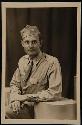
Photograph of Chaplain (Capt.) Emil Kapaun as a 1st. Lt.
-
FORT HOOD, Texas -- The 1st Cavalry Division will host a Distinguished Service and Welcome Ceremony, 10 a.m., Feb. 7, at the division headquarter's Cooper Field.
The Cav will be recognizing retiring troopers and honoring the distinguished service of individuals throughout the division.
Media representatives interested in covering the event, please click here.
-
July 10, 2012 1st Cav hails, farewells senior leadership
By Sgt. Kim Browne1st Cav. Div. Public Affairs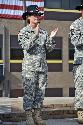
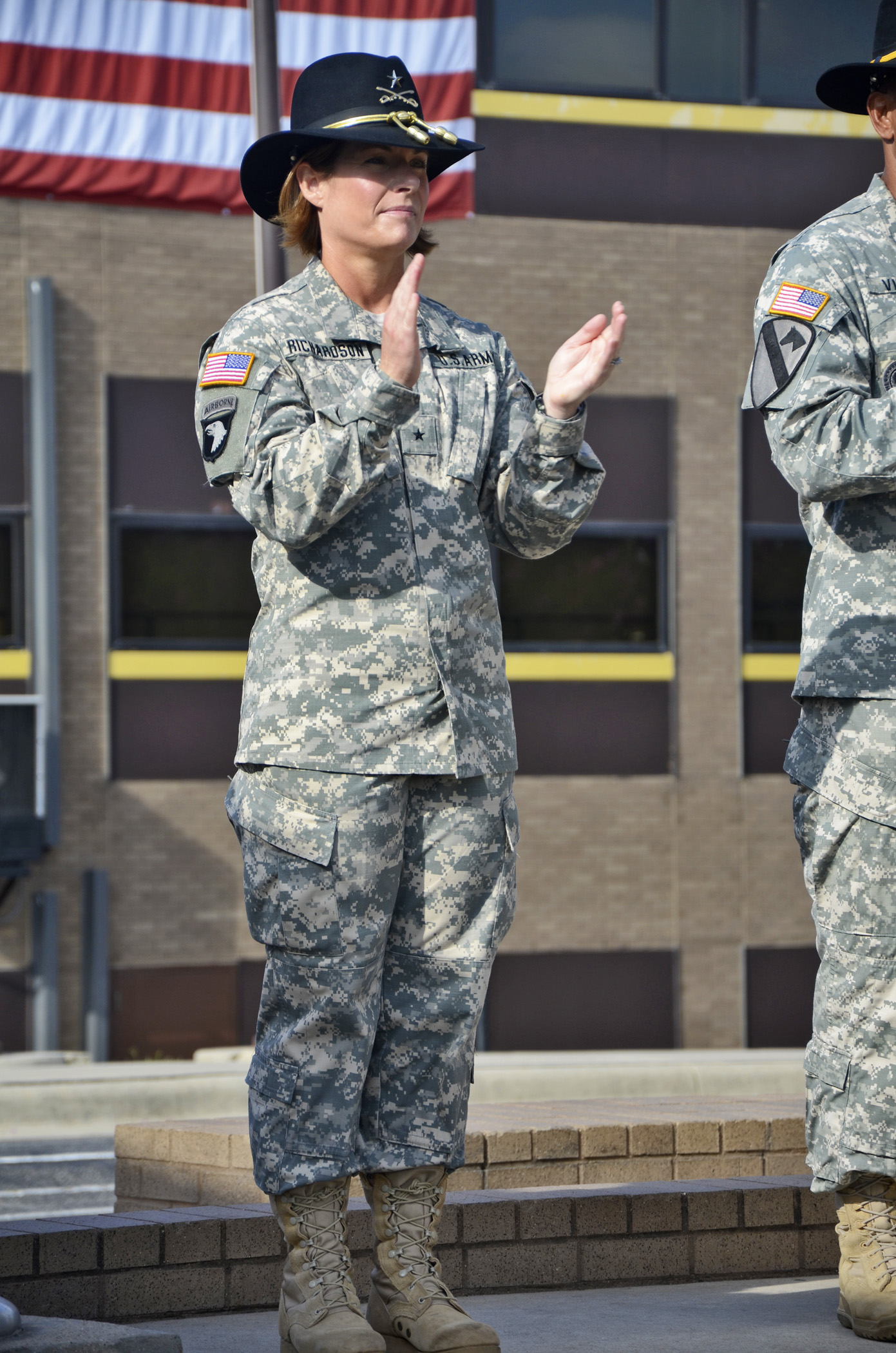
FORT HOOD, Texas - Brig. Gen. Laura Richardson, deputy commanding general of support for the 1st Cavalry Division, claps to the playing of "Garry Owen" during a Patch Ceremony, July 5 on Cooper Field. This Patch Ceremony farewelled Command Sgt. Maj. Isaia Vimoto, former division command sergeant major, and recognized the division's changing of deputy commanding general of support from Brig. Gen James Richardson to Brig. Gen. Laura Richardson. With taking this position, Laura is making a first in the history of the Army by being the first female deputy commanding general of a maneuver division. She is also taking her husband’s position who is moving on to be the deputy commanding general of III Corps. (Photo by Sgt. Kim Browne, 1st Cav. Div. Public Affairs)
FORT HOOD, Texas – A rich history is one of many things that make the 1st Cavalry Division what it is today. Their flare of traditional ceremonies when honoring the Cav’s Soldiers is another.
America’s First Team farewelled Command Sgt. Maj. Isaia Vimoto, former division command sergeant major, Brig. Gen. James Richardson, former deputy commanding general of support, 1st Cav. Div., and hailed Brig. Gen. Laura Richardson, deputy commanding general of support for the division, during a Patch Ceremony, July 5, on Cooper Field.
Vimoto was awarded the Legion of Merit Medal for his accomplishments during his time with the Cav.
“To our First Team Troopers and leaders; I had a blast serving you,” Vimoto said. “It has been a blessing serving as your division command sergeant major and I can honestly tell you that I had learned so much by watching you in action both in combat and here at home station.”
Also during the ceremony Brig. Gen. James Richardson stepped down as the division’s deputy commanding general of support and handed the reins over to his wife Brig. Gen. Laura Richardson.
“While I leave the First Team with a heavy heart, I take comfort in the notion that I am not leaving them entirely behind,” James said. “Going to III Corps will allow me to continue sharing in the unique community that is Fort Hood.”
Laura is coming to the Cav from the United States Army Operational Test Command on West Fort Hood, where she was the commanding general.
“I am truly honored and humbled to join this legendary division, the 1st Cavalry Division, who has served this nation since 1921, building a cavalry heritage rich in pride and tradition.” she said.
Brig. Gen. Laura J. Richardson grew up in Colorado and was commissioned a second lieutenant aviation officer upon graduation from Metropolitan State College in Denver.
Laura’s first assignment after flight School was in Korea with the 17th Aviation Brigade where she served as a platoon leader, company executive officer, brigade staff officer and company commander.
She next served at Fort Hood, Texas on the III Corps staff and in the 6th Cavalry Brigade as a company commander and brigade adjutant.
Upon leaving Texas she was assigned to Fort Leavenworth, Kansas serving at the Battle Command Training Program as an observer trainer, followed by attendance to the United States Army Command and General Staff College.
She was next assigned to the 101st Airborne Division (Air Assault) at Fort Campbell, Kentucky to serve in the 9th Battalion, 101st Aviation Regiment, an assault helicopter battalion, as the operations officer and executive officer. Then she was selected to serve as the military aide to Vice President Al Gore in Washington D.C.
Laura then returned to Fort Campbell, KY and the 101st Airborne Division (Air Assault) where she served as the division deputy of operations and following as commander of the 5th Battalion, 101st Aviation Regiment, an assault helicopter battalion, and deployed to Iraq in support of Operation Iraqi Freedom.
Following her battalion command, she was assigned to the Pentagon on the Army Staff in the operations section and served as deputy director and then director, Army's Transformation Office.
After her Pentagon tour, she attended the Industrial College of the Armed Forces at Fort McNair in Washington, D.C., and was the garrison commander of Fort Myer, Va. and Fort McNair, Washington D.C. After command she served as the Army's Liaison Officer to the United States Senate.
Laura’s military education includes the Aviation Officer Basic and Advanced Courses, Army Rotary Wing Course, UH-60 Blackhawk Course, Air Assault School, Airborne School, United States Army Command and General Staff College, and the Industrial College of the Armed Forces.
Her awards and decorations include the Defense Superior Service Medal, Legion of Merit Medal with two oak leaf clusters, Bronze Star Medal, Meritorious Service Medal with three oak leaf clusters, Air Medal (seven), and the Joint Service Commendation Medal.
Brig. Gen. Laura Richardson is also making history for America’s First Team and the United States Army; she is the first female deputy commanding general of a maneuver division.
“[Laura] brings with her incredible talent and inspiration,” said Maj. Gen. Anthony Ierardi, commanding general of the Cav. “She has masterfully commanded at every level from platoon to brigade and excelled at diverse assignments of strategic influence.”
Brig. Gen. James Richardson remains on Fort Hood and is now the deputy commanding general of III Corps.
Command Sgt. Maj. Vimoto has moved on to Fort Bragg, N.C. where he will be the command sergeant major of the XVIII Airborne Corps.
-
July 10, 2012 First Team changes command
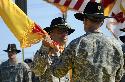
FORT HOOD, Texas - Maj. Gen. Anthony Ierardi, commanding general of the 1st Cavalry Division, receives the division’s colors from Lt. Gen. Donald Campbell, commanding general of Fort Hood and III Corps, during the First Team’s change of command ceremony June 14, on Cooper Field. (Photo by Sgt. Kim Browne, 1st Cav. Div. Public Affairs)
By Sgt. Kim Browne1st Cav. Div. Public AffairsFORT HOOD, Texas – This time last year the 1st Cavalry Division Headquarters celebrated the Army’s birthday with a cake cutting and donning of the biggest patch in the Army to their right shoulders while deployed to Bagram, Afghanistan. This year while the Army celebrated it’s 237th birthday the division experienced the passing of it’s colors from one major general to another.
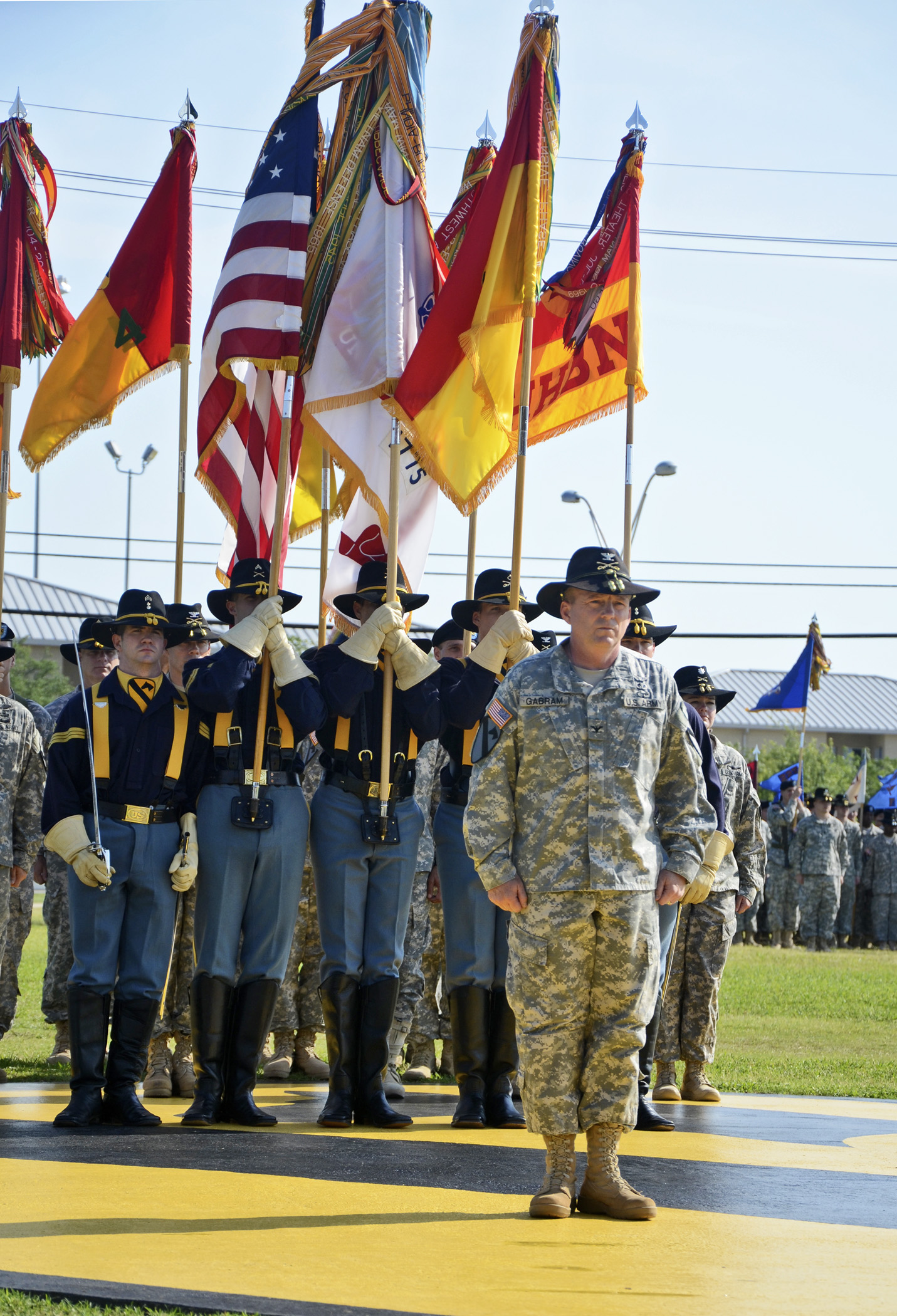
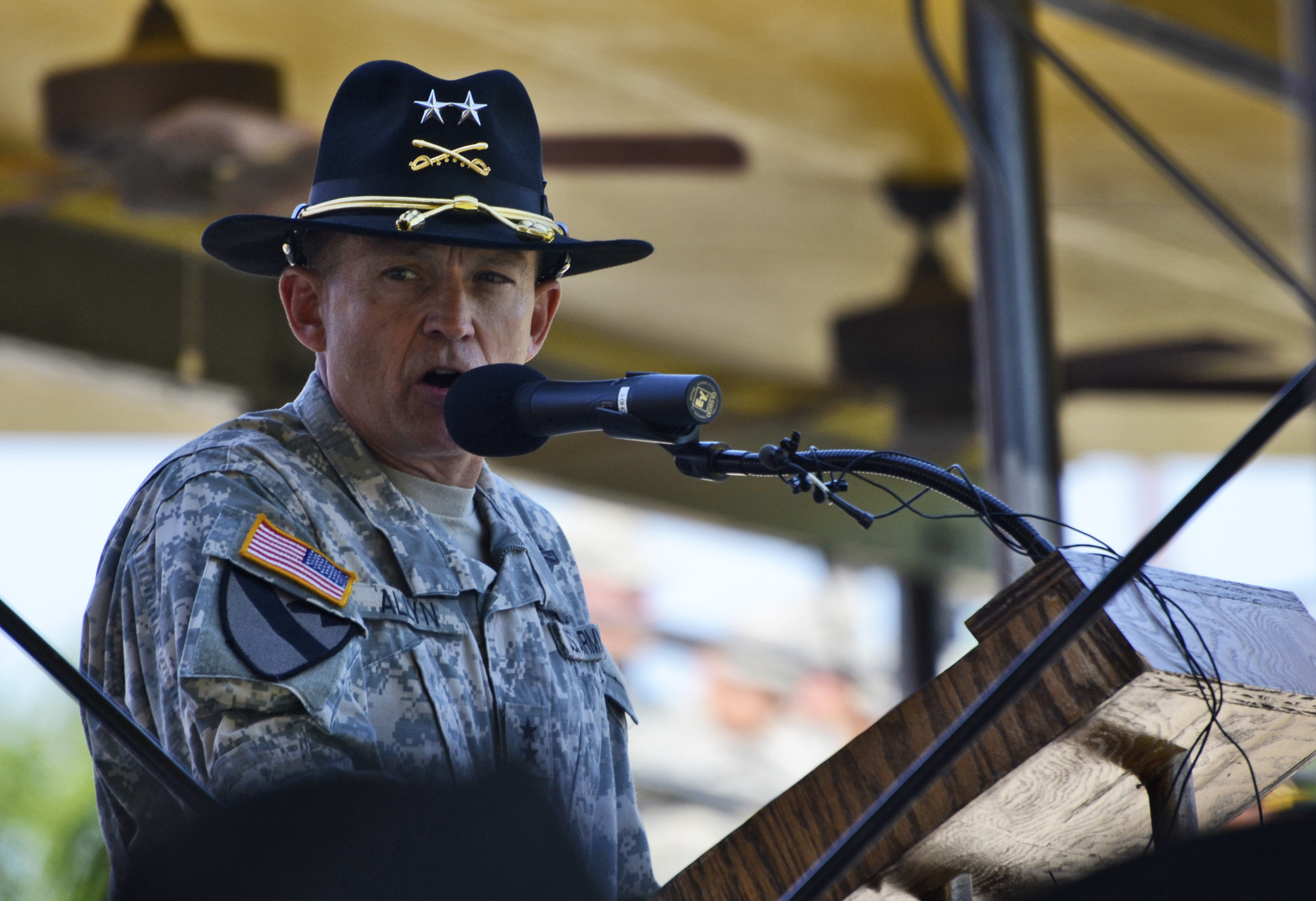
Maj. Gen. (promotable) Dan Allyn, former commanding general of the division, passed on the reins of America’s First Team to Maj. Gen. Anthony Ierardi, commanding general of the 1st Cav., June 14 on Cooper Field.
“It is indeed an honor and privilege to serve again with the tremendous Soldiers of the 1st Cavalry Division,” Ierardi said. “We will remain focused on our mission, on care for our Soldiers and their families, and on the team of teams that is the 1st Cavalry Division.”
Ierardi comes to the First Team from the Office of the Deputy Chief of Staff as the director of force management.
He graduated from Washington and Lee University with a degree in Business Administration and holds a Master of Arts degree in Latin American Studies from Georgetown University. He is also a graduate of U.S. Army Command and General Staff College and the U.S. Naval War College.
His prior assignments include serving as the director of Joint and Futures with the Office of the Deputy Chief of Staff and as the deputy commander for Programs of the Combined Security Transition Command-Afghanistan.
He commanded Joint Task Force North at Fort Bliss, Texas. He also served as director of capabilities developments at the U.S. Army Capabilities Integration Center, U.S. Army Training and Doctrine Command at Fort Monroe, Virginia.
Ierardi was the chief of staff of the 2nd Infantry Division at Camp Red Cloud, Republic of Korea. While in Korea he commanded the 1st “Iron” Brigade, 2ID.
The commanding general is no stranger to Fort Hood. He served as the operations officer of the division and had also commanded the 1st Squadron, 7th Cavalry Regiment “Gary Owen.”
Earlier in his career, he was a cavalry troop commander in the 2nd Squadron, 1nd Armored Cavalry Regiment in Bamberg, Germany and participated in Operation Desert Storm.
Maj. Gen. Ierardi has trained and served as a Latin American Foreign Area Officer. He was first a student attending the Mexican Army’s Command and General Staff College (Escuela Superior de Guerra) in Mexico City. Later he became the Aide-de-Camp to the commander of the U.S. Southern Command.
His awards include the Defense Superior Service Medal, Legion of Merit, Bronze Star, Defense Meritorious Service Medal, Meritorious Service Medal, Army Commendation Medal, and Army Achievement Medal.
Ierardi is married to Mrs. Angela Ierardi and they have two sons.
“[Ierardi] comes to us with a wealth of experience earned during tough and diverse assignments,” said Lt. Gen. Don Campbell, commanding general of III Corps and Fort Hood. “I am truly excited and honored to have Tony and Angela join the III Corps and 1st Cavalry Division Teams and I look forward to serving with both of them.”
Allyn carries on with his family to Fort Bragg, North Carolina to take command of the XVIII Corps.
“This is a tough day for Team Allyn, but as with every day serving America’s finest, it’s one filled with inspiration,” Allyn said. “I am blessed to hand over the reins to an outstanding commander, a man of great intellect, vision, and proven leadership: Maj. Gen. Tony Ierardi.”
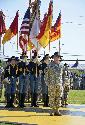
FORT HOOD, Texas - Col. Douglas Gabram, chief of staff for the 1st Cavalry Division, presents the colors, officers, noncommissioned officers, and Soldiers to the command during the division’s change of command ceremony June 14, on Cooper Field. (Photo by Sgt. Kim Browne, 1st Cav. Div. Public Affairs)
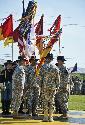
FORT HOOD, Texas - Command Sgt. Maj. Isaia Vimoto, command sergeant major of the 1st Cavalry Division, prepares to pass off the division’s colors during the Cav’s change of command ceremony June 14, on Cooper Field. (Photo by Sgt. Kim Browne, 1st Cav. Div. Public Affairs)
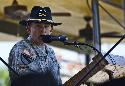
FORT HOOD, Texas - Maj. Gen. Dan Allyn, former commanding general of the 1st Cavalry Division, gives his closing remarks after relinquishing command of the division during the Cav’s change of command ceremony. (Photo by Sgt. Kim Browne, 1st Cav. Div. Public Affairs)
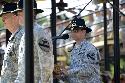
FORT HOOD, Texas - Maj. Gen. Anthony Ierardi, commanding general of the 1st Cavalry Division, gives a speech during the division’s change of command ceremony after taking command as the new commanding general of America’s First Team June 14, on Cooper Field. (Photo by Sgt. Kim Browne, 1st Cav. Div. Public Affairs)
-
June 5, 2012 First Team remembers the fallen
By Sgt. Kim BrowneHQ, 1st Cav. Div. PAO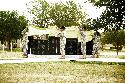
The command team of the 1st Cavalry Division unveil the Operation Enduring Freedom monuments during the divisions Memorial Re-dedication Ceremony May 30 on Cooper Field.
FORT HOOD, Texas – As the face of war continues to change, the promise of remembering our fallen is something the 1st Cavalry Division has held on to and continues to show with each passing deployment.
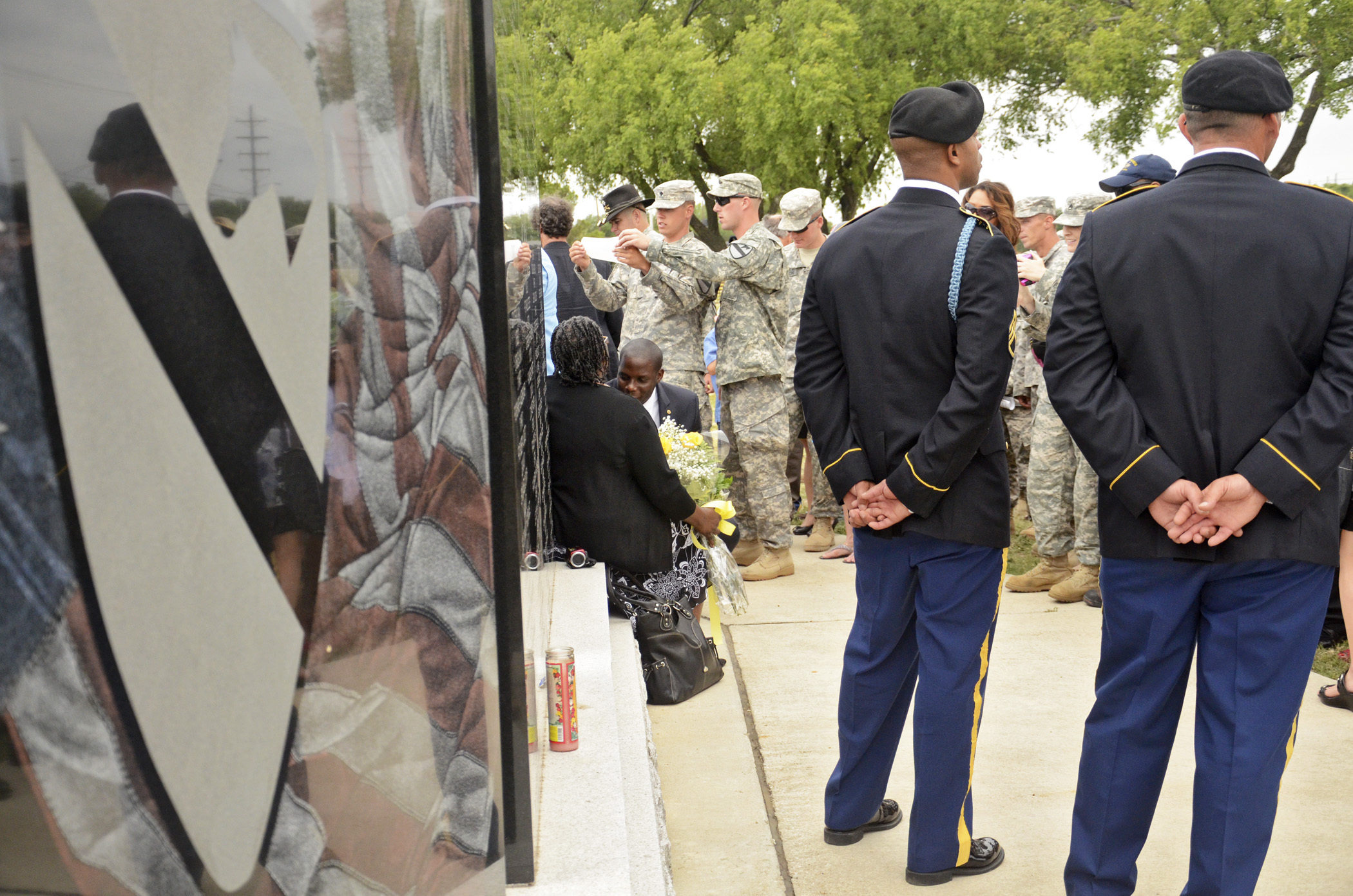
America’s First Team honored their fallen from Iraq and Afghanistan during a Memorial Rededication Ceremony, May 30 on Cooper Field.
The ink-black granite memorial bears witness to all that lost their lives while deployed with the division in support of Operation Iraqi Freedom and Operation New Dawn in Iraq, and Operation Enduring Freedom in Afghanistan.
“It’s a beautiful monument and it’s nice to see that you’re honoring the soldiers,” said Mary Pasker, Gold Star mother of Sgt. 1st Class Terryl Pasker.
Terryl, who served with the 2nd Brigade Combat Team, 34th Infantry Division, Iowa National Guard, was killed-in-action July 9, 2011 in eastern Afghanistan.
“By commissioning this monument, we have charged these stones to keep vigil over the memory of our fallen,” said Maj. Gen. Dan Allyn, commanding general of the 1st Cavalry Division. “And in turn they charge us never to waiver in our commitment to honoring the legacy of their precious charges.”
Names of the 17 U.S. soldiers from Operation New Dawn were engraved into the original, horseshoe-shaped monument, along with an additional campaign stone that details the mission that closed the war in Iraq.
OND began, Sept. 1, 2010, and marked the end of military action in Iraq. A little over two years later on Dec. 15, 2011, OND concluded more than eight years of combat. On Dec. 18, 2011, soldiers of the First Team’s own 3rd Brigade Combat Team were the last to leave Iraqi territory and cross into Kuwait.
Just to the east, three new memorial walls now stand to remember those lost during the division’s latest deployment to eastern Afghanistan for Operation Enduring Freedom.
OEF and the global War on Terror were sights unseen and a historical first for the Cav. The division headquarters took over authority May 19, 2011 from the 101st Airborne Division (Air Assault) of Combined Jointed Task Force-1, Regional Command-East, headquartered in Bagram, Afghanistan.
“Captured on these stones are the names of soldiers from ten brigades and eight divisions within our Army,” Allyn said. “The sacrifice of sailors and airmen from the U.S. Navy and Air Force is also recorded, as well as the names of Service Members from three allied countries who served with the First Team and CJTF-1 in Afghanistan.”
The new OEF walls contain the names of 104 U.S. Service Members and civilians; 39 coalition partners, to include Poland, France and Jordan; and two military working dogs.
These additions carry on a legacy to remember the fallen. This legacy now physically connects the heroes of today’s wars with their brethren from nearly half a century ago.
“The granite is from the same quarry in India that was used for the Vietnam Memorial,” said retired Command Sgt. Maj. Dennis Webster, president of the 1st Cavalry Division Association. “This is the best division memorial that I have yet to see.”
The division’s memorial was first dedicated April 4, 2006 and is rededicated following every deployment of the division’s, to honor those who have served and given the ultimate sacrifice.
“The nation that forgets it’s defenders will itself be forgotten.” -Calvin Collidge.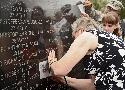
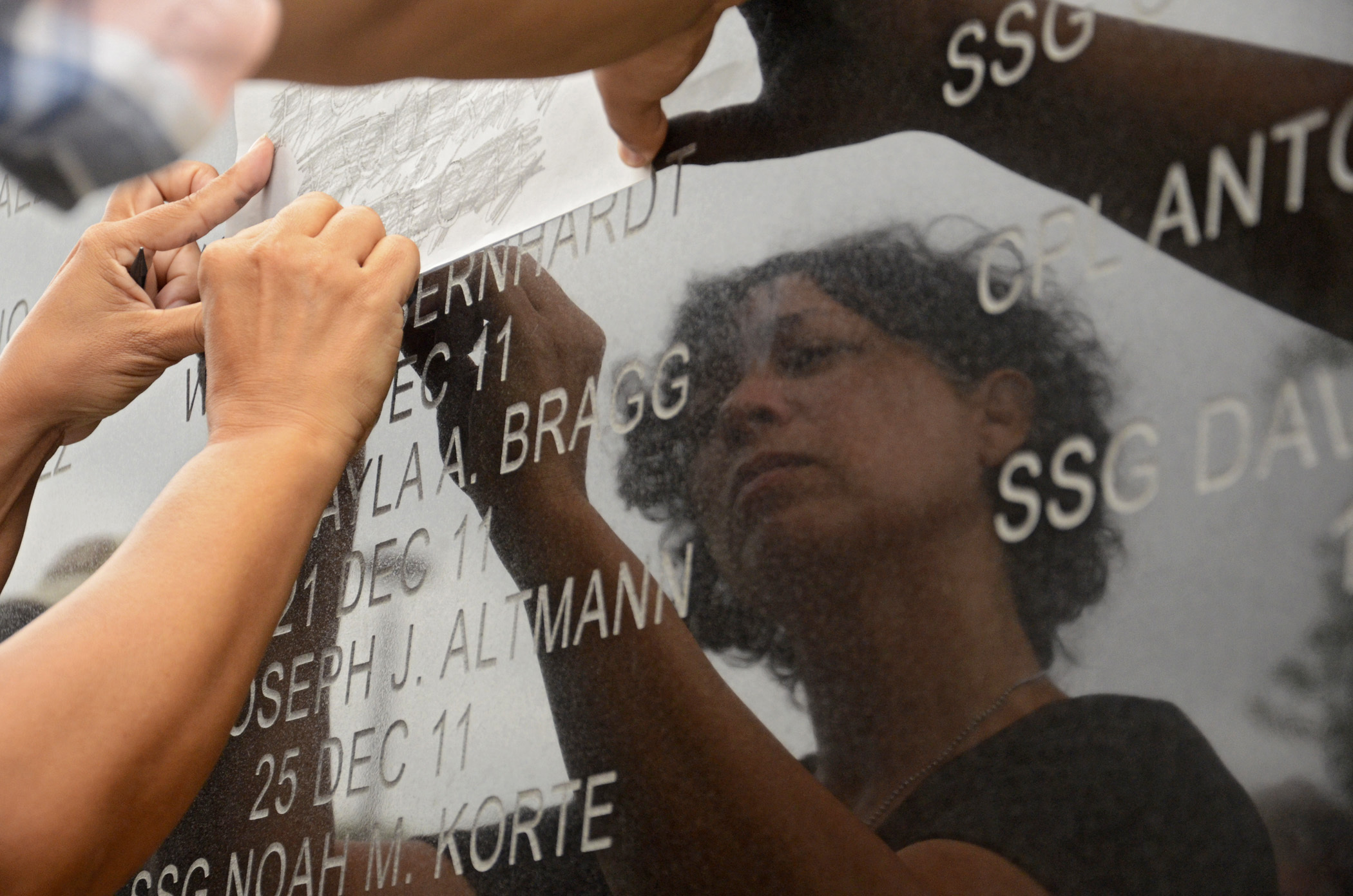
Mary Pasker, a Gold Star family member, traces the name of her son, Sgt. 1st Class Terryl L. Pasker, who was killed in action July 9, 2011 in eastern Afghanistan, after the 1st Cavalry Divisions Memorial Re-dedication Ceremony, May 30, on Cooper Field.
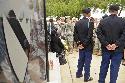
Family and friends of fallen service members pay their respects May 30, at the 1st Cavalry Divisions Memorial Re-dedication Ceremony on Cooper Field.
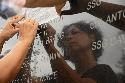
A Gold Star family member of Pfc. Jalfred D. Vaquerano, who was killed in action Dec. 13, 2011 in eastern Afghanistan, traces his name from the newly unveiled Operation Enduring Freedom monument after the 1st Cavalry Divisions Memorial Re-dedication Ceremony May 30 on Cooper Field.
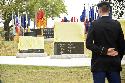 A rifleman stands ready before the 1st Cavalry Divisions Memorial Re-dedication Ceremony May 30 on Cooper Field
 -
May 18, 2012 1st Cavalry Division remembers its fallen heroes
FORT HOOD, Texas -- The 1st Cavalry Division will remember its fallen heroes by rededicating its 1st Cavalry Division Memeorial at 10:00 a.m. on May 30 at Cooper Field here.
The ceremony will unveil additions to its Operation Iraqi Freedom Memorial, as well as its new Operation Enduring Freedom Memorial. 162 names of fallen heroes have been added to the memorial: 17 from OIF and Operation New Dawn, and 145 from OEF.
This event is open to the public and all are welcome to come show their support and honor these brave Cavalry Troopers.
Media representatives interested in covering the event, please click here.
-
April 23, 2012 Cav HQ returns from Afghanistan
By Sgt. Kim BrowneHQ, 1st Cav. Div. PAO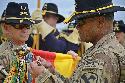
FORT HOOD, Texas - Command Sgt. Maj. Isaia Vimoto, the command sergeant major of the 1st Cavalry Division, adds the Operation Enduring Freedom campaign ribbon to the division’s colors April 20 on Cooper Field. (U.S. Army Photo by Sgt. Kim Browne, 1st Cav Div Public Affairs.)
FORT HOOD, Texas –The 1st Cavalry Division’s Cooper Field has seen many ceremonies over the years. From changes of command to retirements but this ceremony marks an historical event for the division.
Troopers from the Cav headquarters returned from their first deployment in Afghanistan after a year, April 20, to Cooper Field.
Uncasing the division’s colors was their first order of duty, to show the First Team’s Headquarters was back home but the order to “charge” was shortly thereafter.
For the commander to yell “charge” signified to the families and the returning Soldiers to reunite again after their year apart.
“It’s great to be reunited with the family,” said Lt. Col. Chad Carroll, the public affairs officer for the division. “It was a good deployment, made a lot of great progress out there but it’s always great to be home.”
While deployed, the division was in charge of Regional Command-East, also known as Combined Joint Task Force-1. RC-East covers 14 Afghan provinces, roughly the size of the state of Ohio, with 450 miles of border with Pakistan.
They also oversaw the actions and campaigns of 31,000 Coalition Forces Soldiers from 13 nations.
RC-East had many successes over the year while under CJTF-1.
Operations such as Hammer Down and Hammer Down II disrupted insurgent operations and also continued the expansion of Afghan National Security Forces capabilities.
Operation Knife Edge also occurred under the watch of the division.
Knife Edge consisted of Afghan Security Forces and their NATO allies pushing against and reducing the Al Qaeda-linked Haqqani network along the troubled Pakistani border.
CJTF-1’s primary mission in Afghanistan was to provide security, governance and development for the people of RC-East.
14 Provincial Reconstruction Teams also fell within RC-East. The PRT objectives are to extend the authority of the Afghan central government, and to facilitate reconstruction.
Transitioning securities from Coalition Forces to Afghan Forces was also a work-in-progress for RC-East.
Within the year they transitioned the entire provinces of Bamyan and Panjshir, Parwan Province transitioned except for two districts. Several major districts and cities transitioned to Afghan forces including; Mehter Lam, the capital city of Laghman Province - Jalalabad, the capital city of Nangahar Province - and Surobi District, Kabul Province.
“The Afghan Security Forces are much more capable now then they were a year ago,” said Maj. Gen. Daniel Allyn, the commanding general of the 1st Cav. “They get stronger every single day and are very confident of their capabilities. And they are capable of defeating the insurgents and enemies of Afghanistan.”
The command also had individual Soldier accomplishments as well as hardships.
Nine Soldiers were awarded Silver Star Medals and 43 Bronze Star Medals with Valor devices while under CJTF-1. However, there were more than 1,200 Purple Heart Medals earned.
"We've completed our mission in Afghanistan and we're ready to start the next leg of the journey," Allyn said.
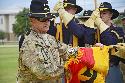
FORT HOOD, Texas - Maj. Gen. Daniel Allyn, the commanding general for the 1st Cavalry Division, uncases the division’s colors on Cooper Field after returning home to Fort Hood April 20, from a year deployment to Afghanistan. (U.S. Army Photo by Sgt. Kim Browne)
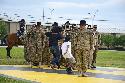
FORT HOOD, Texas - The children of Command Sgt. Maj. Isaia Vimoto, the command sergeant major of the 1st Cav. Div., run out to embrace him after receiving the command to “charge” from the III Corps commander, April 20, on Cooper Field. Vimoto and the rest of the division headquarters had just returned from a year deployment to Afghanistan. (U.S. Army Photo by Sgt. Kim Browne)
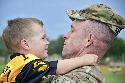
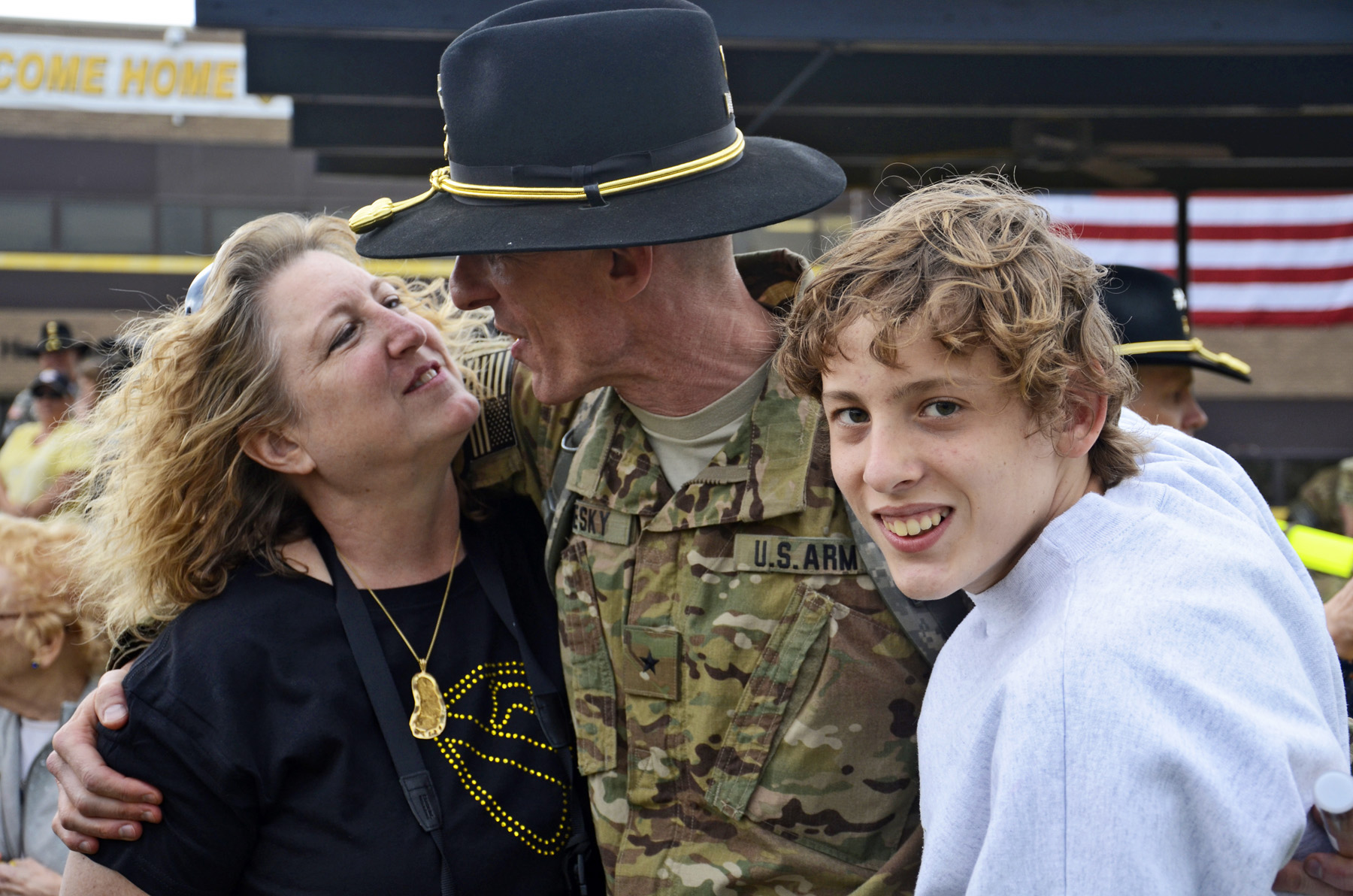
FORT HOOD, Texas - Col. Daniel Hurlbut, the operations officer-in-charge for the 1st Cavalry Division, holds his son after a redeployment ceremony April 20 on Cooper Field. The division headquarters had just returned from a year deployment in Afghanistan. (U.S. Army Photo by Sgt. Kim Browne, 1st Cav. Div. Public Affairs)
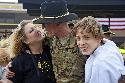
FORT HOOD, Texas - Brig. Gen. Gary Volesky, the maneuvers general for the 1st Cavalry Division, hugs his wife and son, April 20, after a redeployment ceremony on Cooper Field. The division headquarters had just returned from a year deployment in Afghanistan. (U.S. Army Photo by Sgt. Kim Browne, 1st Cav. Div. Public Affairs)
-
April 10, 2012 Returning from another Cavalicious deployment
By Sgt. Kim Browne1st Cav. Div. Public Affairs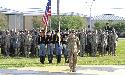
FORT HOOD, Texas – Soldiers from the 1st Cavalry Division wait in formation to receive the “Charge” command from the commander, April 6, at Cooper’s Field, before rushing to see their friends and family. The Soldiers have just returned from a year deployment to Afghanistan in support of OEF XII. (U.S. Army photo by Sgt. Kim Browne, 1st Cavalry Division Public Affairs)
FORT HOOD, Texas –1st Cavalry Division friends and family members lifted welcome home signs, American flags and division logos into the air as two white buses pulled up in front of Cooper’s Field.
An advanced party of Soldiers from America’s First Team arrived home after a year deployment in Afghanistan, April 6, on Cooper’s Field.
“It’s time,” said Nicole Vess, wife of Sgt. 1st Class Donald Vess, Headquarters 1st Cav. “We are very excited.”
Also attending the ceremony was the United Services Organizations.
“We are providing coffee, sodas, snack and a smile to the spouses and friends of the returning Soldiers,” said Marietta Groh and Kristi Brecheisen, USO volunteers. “We are really excited to see the Soldiers come home and we are loving the energy from the families.”
After ‘Living the Legend’ successfully for a year, then passing on the legacy to the 1st Infantry Division, the division’s Soldiers begin to come home.
Their mission of supporting Operation Enduring Freedom XII was the first time the division had deployed to Afghanistan.
While deployed the First Team was in charge of Regional Command-East and the 31,000 Coalition Forces Soldiers within it.
With the assistance of these Soldiers, the division was able to provide security, governance and development to the people of 14 Afghan provinces in RC-East.
This initial group of First Team Soldiers returning home marks a major milestone in 1st Cav. history; by supporting OEF XII in Afghanistan for their first time and being the first armored unit to do so.
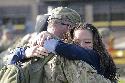
FORT HOOD, Texas – 1st Sgt. James Funk, 1st Sgt. of Operations Company, Headquarters and Headquarters Battalion, 1st Cav. Div., embraces his daughter, April 6, at Cooper’s Field, after returning from a year deployment to Afghanistan in support of OEF XII. (U.S. Army photo by Sgt. Kim Browne, 1st Cavalry Division Public Affairs) 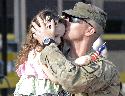
FORT HOOD, Texas – Capt. Merlin Dupont, Administrative officer-in-charge, Headquarters and Headquarters Battalion, 1st Cav. Div., kisses his daughter, April 6, at Cooper’s Field, after returning from a year deployment to Afghanistan in support of OEF XII. (U.S. Army photo by Sgt. Kim Browne, 1st Cavalry Division Public Affairs)

















Events
Links
- First Team Web Page
- First Team Facebook
- First Team Twitter
- First Team Flickr
- First Team YouTube